Houston's Preferred Contractor LLC
Outdoor Kitchens in League City, TX
Serving League City, TX

Outdoor Kitchens in League City, TX

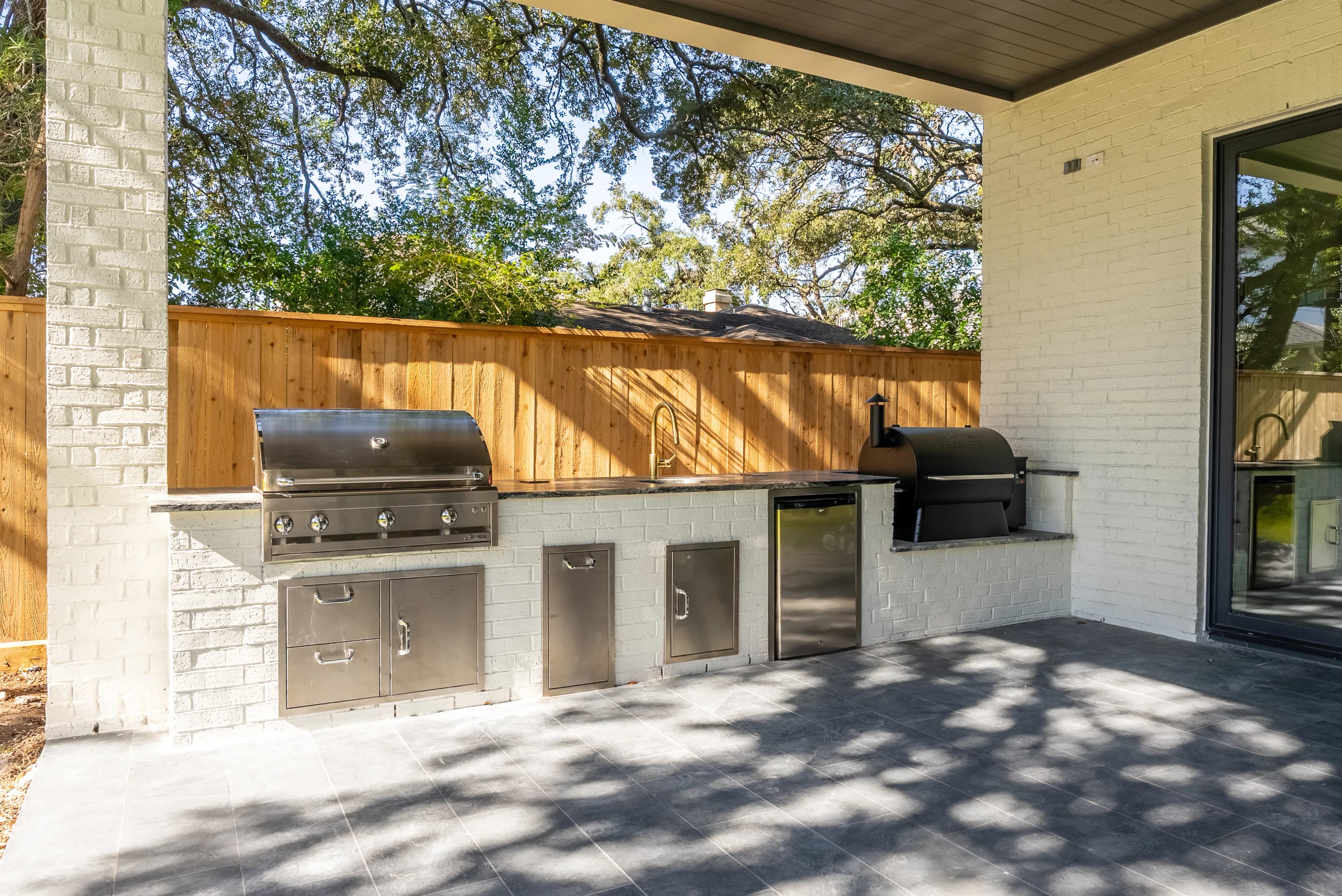
An outdoor kitchen near Galveston Bay has to handle more than a Houston summer — the humidity is higher, the air carries salt, and the appliances and masonry have to shrug off both for years, not one season. We build the full working kitchen — grill, burners, refrigeration, storage — into stone or stucco surrounds, with stainless equipment and marine-grade hardware selected because they hold up this close to the water, not because they photograph well from an inland showroom.

Serving League City, TX

Outdoor Kitchens for League City Homes

An outdoor kitchen near Galveston Bay has to handle more than a Houston summer — the humidity is higher, the air carries salt, and the appliances and masonry have to shrug off both for years, not one season. We build the full working kitchen — grill, burners, refrigeration, storage — into stone or stucco surrounds, with stainless equipment and marine-grade hardware selected because they hold up this close to the water, not because they photograph well from an inland showroom.

Most League City outdoor kitchens go up in the evening, after the afternoon heat breaks, so task lighting and ventilation get designed for after-dark cooking and gathering, not just daytime use. Gas, water, and electrical are trenched from the house by licensed trades, HOA architectural review applies in South Shore Harbour, Victory Lakes, and League City's other master-planned sections, and a City of League City permit covers the structural and utility work. We handle both submittals and price the whole scope in a free itemized quote.

What's Included

  • Built-in grills, burners, and appliance integration
  • Gas, water, and electrical runs
  • Masonry, stone, and weather-rated counter surrounds
  • Task lighting and ventilation planning
  • Coordination with patio covers and hardscape
Outdoor Kitchens Guide

Planning Outdoor Kitchens in League City What to Decide First.

Which way should the kitchen face when the breeze comes off the bay?

Siting is the first decision on a League City backyard and it is the one most people make by default, usually by putting the grill wherever the builder left a slab. The prevailing breeze off Galveston Bay pushes smoke somewhere, and if the cooktop sits upwind of the seating, every dinner has a haze over it. We walk the yard at the time of day you will actually cook, note which way the wind moves through the fence line, and place the grill and its hood so smoke leaves the patio instead of crossing it. On lots in South Shore Harbour that back up to water, that check matters twice as much because the breeze is steadier and stronger.

Pools and existing covers set the other limits. A kitchen wants to be a few steps from the back door for carrying plates, close enough to the pool to keep an eye on kids, and far enough from any tree canopy that leaves and sap do not land on the counters. Many League City yards from the 1990s and 2000s are compact enough that all three cannot happen at once, so we sketch two or three placements on the survey and talk through the trade-offs before anything is priced. Once the location is fixed, the utility trench routes and the cover plan fall into place around it rather than the other way around.
Straight run, L-shape, or island in the middle of the patio?

A straight run along a wall or fence is the most economical footprint and the easiest one to cover, and it keeps the cook facing the yard. The drawback is that the cook has their back to the guests. An L-shape adds a return leg that becomes bar seating, which is how most families here end up using the space in the evening, with a couple of stools on the outside and the grill safely on the inside. A true island stands free in the patio and lets people gather on three sides, but it needs the most slab area and the longest utility runs, and it only works when the patio is deep enough to walk around it comfortably.

In League City's newer subdivisions the typical back patio is a rectangle of modest depth against the house, which pushes most designs toward the straight run or the L. Where a family has extended the slab or has one of the larger waterside lots, the island becomes realistic. We lay each option out full size with tape on the concrete so you can stand at the grill and see whether the seating, the door swing, and the path to the pool all still work. That ten-minute exercise settles more layout arguments than any drawing does.

Can the kitchen sit on the slab you already have?

A builder patio slab was poured to hold furniture and foot traffic, not several hundred pounds of masonry and appliances on one edge. Before we commit to building on it we check its thickness at the edge, look for existing cracks and any tilt toward the house, and confirm there is room for the cabinet base plus a walkway. On the expansive clay across Galveston County a thin slab can heave or settle at the perimeter, and setting a masonry kitchen on a corner that moves will crack the counters and open the joints within a couple of seasons.

When the existing slab passes, we build on it and save the cost of new concrete. When it does not, or when the kitchen needs to sit beyond the slab edge, we pour a thickened footing under the kitchen line and tie it to the old slab with doweled rebar so the two move together. That also creates a clean opportunity to run the gas, water, and electrical conduit through the new pour instead of cutting the old one. Several days of forming, pouring, and curing come before any block goes up, and we plan that into the schedule rather than treating it as a delay.

How many appliances is too many?

The grill is the only appliance every outdoor kitchen needs. Everything after that is a decision about how you cook and how much you want to maintain in humid, salty air. Side burners earn their place for anyone who makes sauces or boils shrimp outside, which is common this close to the bay. A refrigerator is worth it if the kitchen is more than a few steps from the indoor one, and a waste of a compressor if it is not. Sinks are the item most often regretted, because they require a drain and a supply line that has to be protected from the occasional hard freeze, and most people wash up inside anyway.

Each appliance also pulls a utility. Gas appliances need a line sized for the total load, not just the grill, and a refrigerator and lighting each want a dedicated circuit rather than sharing the patio outlet. We list every appliance you are considering, map its utility requirement, and price the package and the rough-in as separate lines so you can drop one item and see exactly what it saves. That rough-in is completed and inspected before the masonry closes it in, because opening a finished stone surround to add a line later costs far more than the line itself.

What happens between the first site visit and the first cookout?

The site visit covers wind, sun, slab condition, and where the existing gas meter and panel sit, because the distance of those runs affects cost more than most people expect. From there we draw the kitchen with appliance cutouts and utility locations and send a free itemized quote listing masonry, counters, each appliance, each utility run, and any slab work. If your home is in South Shore Harbour, Victory Lakes, or another master-planned section, the HOA package goes in at the same time as the application to the City of League City, which runs its own permitting, so the two reviews overlap.

Construction starts with any concrete work and the utility trenches, then the frame and block, then rough-in inspection, then counters and the appliance set. Stone or stucco finish goes on last along with the lighting. Most kitchens take a few weeks on site once approvals are in hand, with counter fabrication usually the longest lead. We schedule around the summer storm pattern where we can, since a half-finished masonry surround is not something you want sitting uncovered through a tropical system, and we leave you with the gas pressure test and inspection sign-off documented.

Local FAQs

Outdoor Kitchens in League City, TX.

Answers to common questions from League City homeowners planning outdoor kitchens projects.

Stainless steel appliances, marine-grade hardware, and stone or stucco surrounds handle the humidity and salt-tinged air far better than standard-grade materials, which show corrosion and staining within a couple of bay-area seasons. We select every material against that environment, not just against a showroom sample.

For most League City families, that's when the space earns its keep — after the afternoon heat breaks. We design task lighting over the cooking and prep zones along with ambient lighting for the surrounding patio, and plan the electrical circuits for both from the start rather than adding fixtures after the masonry is finished.

In South Shore Harbour, Victory Lakes, and most of League City's other master-planned sections, yes — a permanent structure like this typically needs architectural review before the City of League City permit is finalized. We prepare the drawings and manage both submittals so the approval doesn't hold up construction.

The appliance package, the length of masonry and counter, and the marine-grade hardware a bay-area build calls for are the real cost drivers. We design the full kitchen with you, then deliver a free itemized quote with every appliance, material, and utility run priced as its own line.

Usually, with two checks first. The cover needs enough clearance above the grill for the hood or for open combustion, and the ceiling material over the cooking zone has to be non-combustible or protected. We also confirm the cover's columns and footings are not in the way of the kitchen line or the utility trench. If the cover is one of the small builder units common on League City homes from the 2000s, it is often worth replacing it in the same project so the roof, kitchen, and electrical are designed together.

Either works, and the choice depends on where the meter is and how much you cook. Natural gas means one trenched line from the house, permitted and pressure tested, and then no tanks to swap. Propane skips the trench but ties you to tank exchanges and needs a ventilated enclosure for the cylinder. On most League City lots the meter is close enough that the natural gas run is a small line in the quote, and we recommend it for anyone adding burners beyond the grill.

What Clients Say

Reputations are built over decades. Hear from the partners who have entrusted us with their most critical builds.

Porch Project
"We recently hired HPC to build our porch, and we could not be happier with the results. From start to finish, they went above and beyond expectations. Their attention to detail and commitment to quality really showed in every part of the work."
Zoraida Cordoba
Bathroom Remodel
"He and his team did such a stellar job that I later hired him to help with a remodel of my guest bath. It’s a big and messy undertaking but Alfonso and team did it in a timely manner and with great communication... The customer service he provides really sets these guys apart."
kara bowers
Outdoor Deck
"From start to finish he's been knowledgeable, patient, very humble and a down to earth guy. He also is realistic and works with clients to make their dreams a reality... I love my new elevated deck! If you're looking for a contractor that's not going to bail... HPC is the way to go!!"
Chasiti Latson
Discuss Your Project

Ready to Discuss
Your Project?

Whether you need a high-end residential remodel or a complex commercial buildout, our team is ready to plan and execute with the discipline your Houston-area project deserves.